Spring weeds you didn’t know you needed.
It’s spring. The grass is growing, the gardens are waking up, and the weeds are back.
Your city hates them. Your neighbors spray them. Your HOA might even fine you for them.
But here’s what most people don’t know: some of the most common “weeds” in the Midwest are actually powerful medicine and nutrient-dense food.
Dandelion. Stinging Nettle. Plantain. Purslane. Chickweed.
These plants show up uninvited, thrive in terrible soil, and grow exactly where they’re needed most. And instead of fighting them, maybe it’s time we learned what they actually do.
Why We Call Them Weeds
A weed is just a plant growing where someone decided it shouldn’t be.
Dandelions ruin the aesthetic of a perfect lawn. Plantain cracks through sidewalks. Purslane invades vegetable gardens. Chickweed spreads aggressively in flowerbeds.
But none of these plants are harmful. They’re not poisonous. They don’t damage the soil. In fact, most of them improve it.
The problem isn’t the plants. The problem is our expectation of what a yard should look like.
Lawns became a status symbol in the 1950s. Perfectly manicured grass, no dandelions, no clover, no “weeds.” Chemical companies sold us the idea that anything other than grass was a problem that needed to be sprayed.
Meanwhile, generations before us knew better. Native Americans used these plants for food and medicine. European settlers brought some of them intentionally.1 Herbalists have worked with them for centuries.
We didn’t lose these plants. We just forgot what they were for.
Divine Timing
Here’s what struck me while researching this post: these plants show up exactly when we need them.
Nettle appears in early spring, right when allergies hit hardest. And it happens to be one of the best natural remedies for seasonal allergies.
Plantain grows in compacted soil where kids play and get scraped up. And it’s perfect for drawing out splinters, soothing bug bites, and healing minor wounds.
Chickweed thrives in cool spring weather when skin needs gentle support after a harsh winter.
That’s not random. That’s divine provision.
These weeds were designed by a God who created the earth and us in it. He gave us what we need most, when we need it, right in the dirt we live on.
What is a weed? A plant whose virtues have never been discovered.
Ralph Waldo Emerson
Dandelion: The Most Hated Superfood
Where it grows: Everywhere. Lawns, sidewalk cracks, gardens, fields. If there’s dirt, there’s dandelion.

What it does: The entire plant is edible and medicinal. According to food researcher Jo Robinson in her book “Eating on the Wild Side,” compared to spinach, dandelion leaves have eight times more antioxidants, two times more calcium, three times more Vitamin A, and five times more vitamin K and vitamin E.2 The roots support liver detox and digestion. The flowers make tea, wine, and infused oil.
A 2014 study published in the journal “Preventing Chronic Disease” ranked dandelion greens as number 16 of the top 41 most nutritious foods, beating out popular health foods like kale and broccoli.3
History: Dandelions were brought to North America on the Mayflower in the 1600s, planted intentionally by Puritan colonizers as a food crop and medicinal herb.4 Native Americans quickly recognized its usefulness and incorporated it into their own medicinal practices.5
The myth: “Dandelions ruin lawns.”
The truth: That deep taproot everyone complains about actually aerates compacted soil. Dandelions improve your lawn, not ruin it.
Dandelion is the most sprayed weed in America. And it’s completely harmless, beneficial, and free.
D I Y R E C I P E
Dandelion Root Coffee
- Harvest dandelion roots in early spring or fall when they’re at their most potent.
- Wash thoroughly, chop into small pieces, and roast at 200°F for 2-3 hours until dark brown and fragrant.
- Grind in a coffee grinder. Brew like coffee (1-2 tablespoons per cup of water).
- Add cream and honey if desired.
This roasted root “coffee” supports liver function and digestion without the caffeine.
Stinging Nettle: Don’t Let the Name Fool You
Where it grows: Moist areas, ditches, riverbanks, shaded gardens.
What it does: Stinging Nettle is one of the most nutrient-dense plants on earth. Multiple scientific studies confirm it’s packed with iron, calcium, magnesium, and protein, with nettle leaf powder containing approximately 30% protein.67 It’s anti-inflammatory, which makes it great for allergies, arthritis, and joint pain. It’s rich in chlorophyll, which helps build healthy blood.
Personal story: Years ago, we went camping and accidentally set up our tent in a patch of Stinging Nettle. Joshua was itchy the rest of the day. This was before our herbal days, and he cussed that plant to no end.
Now we make a tincture from it for allergies. Funny how that works.
The myth: “It’s dangerous because it stings.”
The truth: The sting is temporary and harmless. Once you cook or dry nettle, the sting disappears completely. Wear gloves when harvesting fresh nettle, and you’re fine.
Historically, people used nettle to make fabric and rope. Along with flax and hemp, nettle was one of the most important plant-based textile materials in Europe because it grows even in northern climates. During World War I, the German army used nettle fabric for soldiers’ uniforms when cotton was unavailable.89
And here’s the timing: nettle shows up in early spring, right when allergies hit hardest. It grows when you need it most.
D I Y R E C I P E
Nettle Infusion for Allergies
This isn’t tea, it’s a mineral-rich infusion.
– Use 1 ounce of dried nettle leaf (about 1 cup loosely packed) in a quart jar.
– Pour boiling water over the nettle, cover, and let steep for 4-8 hours or overnight.
– Strain and drink 2-4 cups throughout the day. Store in the fridge for up to 2 days.
This delivers a concentrated dose of minerals and natural antihistamines to support your body during allergy season.
Plantain: Your Yard’s First-Aid Kit
Where it grows: Sidewalks, driveways, compacted soil, lawns, trails. Anywhere kids play.
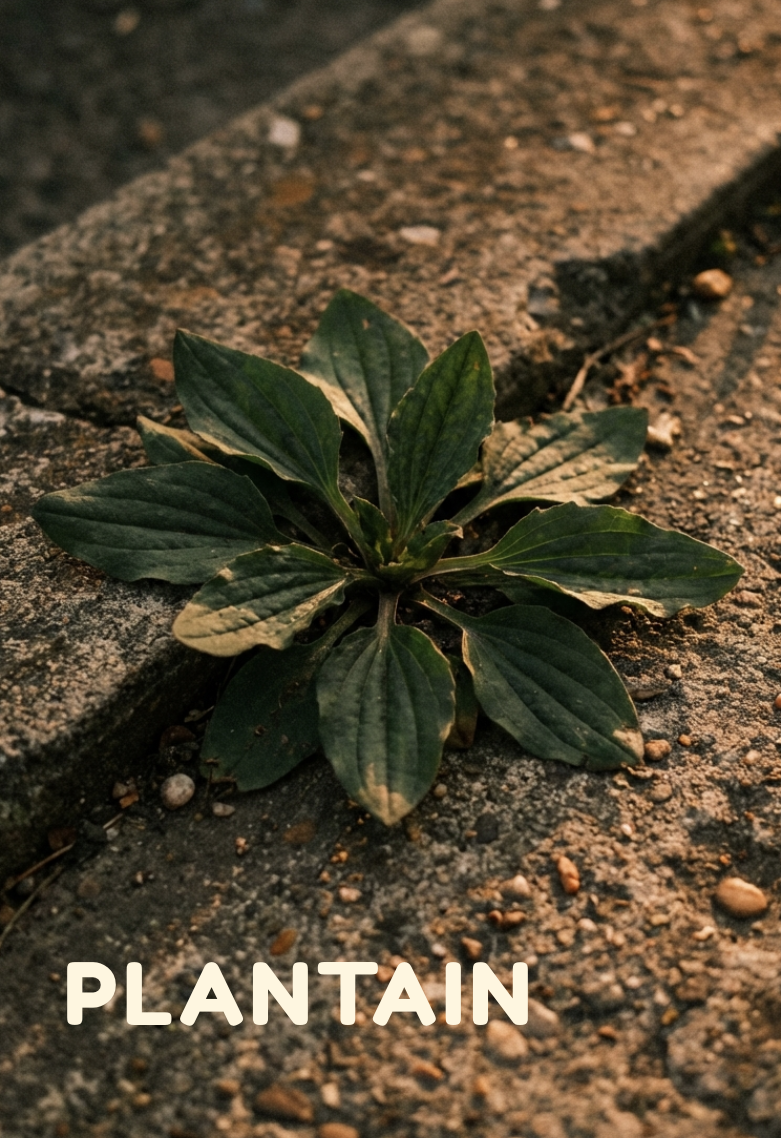
What it does: Plantain (not the banana, the leafy weed) draws out splinters, bee stings, and bug bites when chewed and applied as a poultice. Scientific studies have demonstrated that Plantago major has antimicrobial, anti-inflammatory, and wound-healing properties.1011
History: In 1672, English traveler John Josselyn documented that Native Americans called plantain “English-Man’s Foot, as though produced by their treading.”12 The plant was brought to North America by Puritan colonizers and was known among Native American peoples by the common name “white man’s footprint” because it thrived in the disturbed ecosystems surrounding European settlements.13
The myth: “It’s invasive and ruins walkways.”
The truth: It grows in places nothing else can. And it’s doing you a favor by breaking up that compacted soil.
There are two types: broadleaf (Plantago major) and narrowleaf (Plantago lanceolata). Both are medicinal.
We use plantain in several of our products: Eczema Salve, Drawing Salve, Postpartum Bath Tea, and Pet Stick. It’s gentle, effective, and works.
The “weed” ruining your walkway is actually nature’s band-aid.
D I Y R E C I P E
Plantain Drawing Salve
Infuse dried plantain leaf in olive oil using the folk method:
– fill a jar halfway with dried plantain, cover with olive oil, and let sit for 4-6 weeks in a cool, dark place, shaking daily.
– Strain.
– For every cup of infused oil, add 1/4 cup beeswax.
– Heat gently until beeswax melts, pour into tins, and let cool.
– Apply directly to affected area as needed.
This salve draws out splinters, soothes bug bites, and supports minor wound healing.
Purslane: Omega-3s for Days
Where it grows: Gardens, cracks in pavement, disturbed soil. Anywhere it’s hot and sunny.
What it does: A landmark 1992 study published in the Journal of the American College of Nutrition found that 100 grams of fresh purslane leaves contain about 300-400 mg of alpha-linolenic acid (omega-3 fatty acids), making it one of the richest plant-based sources.14 It’s loaded with vitamins A, C, E, magnesium, and potassium.15 It tastes lemony and tangy, perfect for salads.
History: Mediterranean and Mexican cuisines have used purslane for centuries. It’s not new. We just forgot about it.
The myth: “It’s a garden invader that chokes out vegetables.”
The truth: It’s more nutritious than your salad greens. Maybe stop pulling it and start eating it.
“Sometimes the most powerful foods are the ones growing right under our feet!” —
Susan weed
Purslane loves heat, so it thrives in Midwest summers when other greens bolt and turn bitter. While your lettuce is done, purslane is just getting started.
The succulent texture comes from its ability to hold water during drought. It’s resilient, productive, and completely edible.
Chickweed: Gentle and Powerful
Where it grows: Shaded gardens, lawns, cool moist areas.
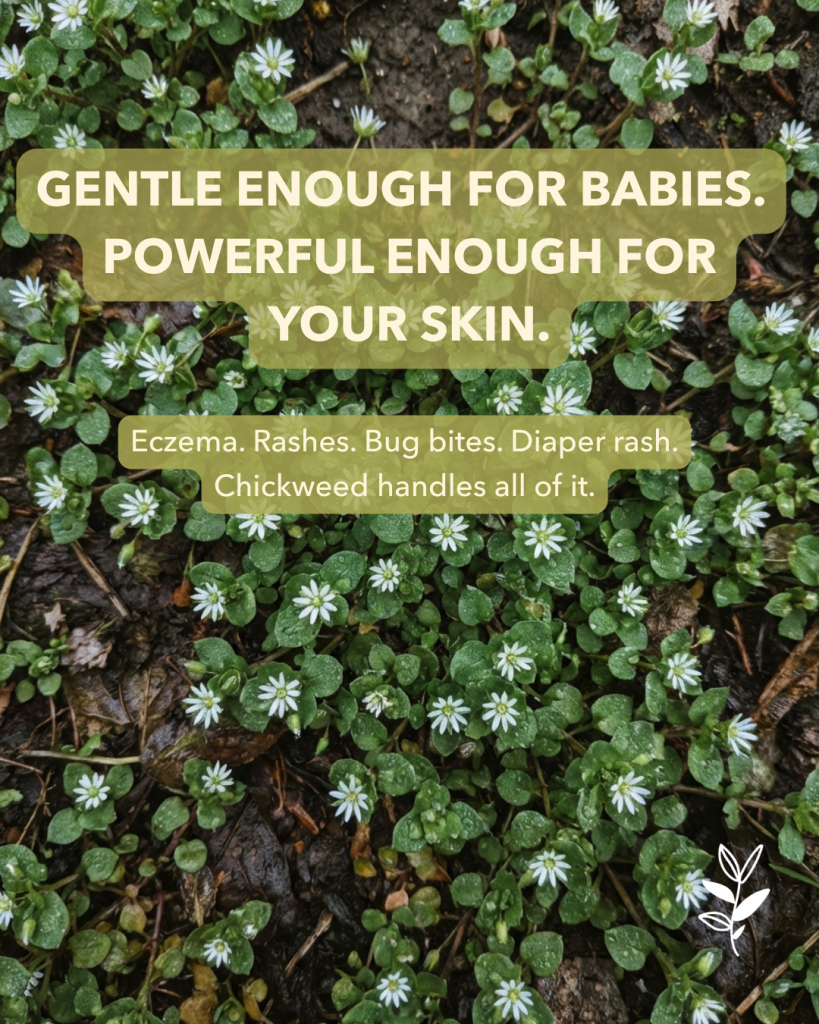
What it does: Chickweed is incredibly soothing for skin. Eczema, rashes, bug bites, diaper rash. Scientific and traditional sources confirm its cooling, anti-inflammatory, and skin-soothing properties.1617 It contains vitamins C and A, B vitamins, magnesium, iron, calcium, and zinc.18
It’s also edible. Mild flavor, great in salads, pesto, or sandwiches.
The myth: “It spreads too aggressively in gardens.”
The truth: It grows in cool weather and dies back in the heat. It’s easy to pull if you need to clear space. And it’s one of the gentlest herbs you can use.
We use chickweed in several of our products: Tallow Stick, Diaper Rash Salve, Eczema Salve, and Itch Eraser Balm. It’s safe for kids, pregnant women, and anyone with sensitive skin.
Chickweed has small white star-shaped flowers and soft, tender leaves. It forms dense mats in early spring and fall. And it’s been used for centuries to calm irritated skin.
If you’re going to harvest these plants, do it responsibly:
- Avoid areas that have been sprayed with chemicals or are near roads (car exhaust settles on plants)
- Harvest from your own yard or ask permission if on someone else’s property
- Only take what you need, leave plenty for pollinators and regrowth
- Positively identify the plant before using it (use a field guide or app if unsure)
- Wash thoroughly before using
For stinging nettle, always wear gloves when harvesting fresh. For everything else, bare hands are fine.
These plants are generally safe, but a few things to keep in mind:
- If you’re pregnant, nursing, or on medication, consult a healthcare provider before using herbs medicinally
- Some people are allergic to plants in the Asteraceae family (which includes dandelion). Start small if you’re unsure.
- Nettle can interact with blood pressure and blood sugar medications. Use caution.
- Always positively identify plants before consuming them
Closing: Shift Your Perspective
These aren’t weeds. They’re medicine growing for free in your backyard.
They show up when you need them. They thrive where nothing else will. They improve the soil, feed the bees, and support your body.
So before you pull them, spray them, or curse them, maybe take a second look.
Maybe let them grow. Maybe even eat them.
Free medicine is everywhere. You just have to know what you’re looking at.
Footnotes
- Wikipedia contributors. (2026). Taraxacum. Wikipedia. https://en.wikipedia.org/wiki/Taraxacum ↩
- Robinson, J. (2013). Eating on the Wild Side. Cited in VOA Learning English. (2019). Dandelions: One of the Healthiest Foods on the Planet. https://learningenglish.voanews.com/a/dandelions-one-of-the-healthiest-foods-on-the-planet-/4895704.html ↩
- Di Noia, J. (2014). Defining Powerhouse Fruits and Vegetables: A Nutrient Density Approach. Preventing Chronic Disease, 11, E95. Cited in VOA Learning English (2019). ↩
- Missouri Department of Conservation. Common Dandelion. https://mdc.mo.gov/discover-nature/field-guide/common-dandelion ↩
- Native Languages. Native American Indian Dandelion Medicine, Meaning and Symbolism. http://www.native-languages.org/legends-dandelion.htm ↩
- Adhikari, B. M., et al. (2016). Comparison of nutritional properties of Stinging nettle (Urtica dioica) flour with wheat and barley flours. International Journal of Food Science. PMC4708629 ↩
- Said, A. A., et al. (2022). Nutritional and pharmacological importance of stinging nettle (Urtica dioica L.): A review. Heliyon, 8(6). PMC9253158 ↩
- Mother Earth News. (2023). Nettle Fiber Processing. https://www.motherearthnews.com/diy/turning-nettles-into-textiles-zbcz2101/ ↩
- Bodros, E., & Baley, C. (2022). Nettle, a Long-Known Fiber Plant with New Perspectives. Materials, 15(12). PMC9230748 ↩
- Zhakipbekov, K., et al. (2023). Antimicrobial and Other Biomedical Properties of Extracts from Plantago major, Plantaginaceae. Pharmaceuticals (Basel), 16(8), 1092. PMC10458736 ↩
- Keshavarzi, M., et al. (2022). Therapeutic Efficacy of Great Plantain (Plantago major L.) in the Treatment of Second-Degree Burn Wounds: A Case-Control Study. International Journal of Clinical Practice. PMC9359829 ↩
- Josselyn, J. (1672). New-Englands Rarities Discovered. Cited in Eat the Invaders. White Man’s Foot. http://eattheinvaders.org/white-mans-foot/ ↩
- Wikipedia contributors. (2026). Plantago major. Wikipedia. https://en.wikipedia.org/wiki/Plantago_major ↩
- Simopoulos, A. P., et al. (1992). Common purslane: a source of omega-3 fatty acids and antioxidants. Journal of the American College of Nutrition, 11(4), 374-382. ↩
- Uddin, M. K., et al. (2014). Purslane Weed (Portulaca oleracea): A Prospective Plant Source of Nutrition, Omega-3 Fatty Acid, and Antioxidant Attributes. The Scientific World Journal. PMC3934766 ↩
- Herbal Reality. (2026). Chickweed (Stellaria media): Benefits, Uses, Safety. https://www.herbalreality.com/herb/chickweed/ ↩
- Wikipedia contributors. (2026). Stellaria media. Wikipedia. https://en.wikipedia.org/wiki/Stellaria_media ↩
- Dr. Axe. (2024). Chickweed: the Edible Weed for Gut, Skin & Immune Health. https://draxe.com/nutrition/chickweed/ ↩