Rethinking Sun Protection from the Ground Up
Most of us born in the late 1970s, through the 80s, and into the 90s grew up with a very clear message about the sun. Cover up. Lather on sunscreen. The higher the SPF, the better. The sun is dangerous, and the products designed to protect us from it are non-negotiable.
I believed that for a long time. And then I started asking questions.
Not because I wanted to be contrarian. That’s the opposite of the type of person I am. But because I had children, and when you have children, you start reading ingredient labels differently. You start wondering who decided what was safe and why. You start noticing that the more we have followed the “more sunscreen is always better” narrative, the more vitamin D-deficient we have become as a population. You start pulling on threads. Some call it a rabbit hole. Some call it a conspiracy. I call it smart parenting.
This is not a post designed to alarm you or push a particular agenda. It is an honest look at what we know, what we are still learning, and why a growing number of people, including dermatologists, researchers, and everyday parents, are asking the same questions I started asking a few years ago.
The Sun Is Not the Villain
For most of human history, sun exposure was simply part of being alive. We worked outside, we played outside, we built entire civilizations around the rhythms of daylight. The idea that moderate sun exposure is inherently dangerous is, historically speaking, a very recent development.
Sunlight triggers vitamin D synthesis in the skin, a process that cannot be adequately replicated through diet alone for most people. Vitamin D is not just a vitamin. It functions more like a hormone, regulating immune function, bone density, mood, cardiovascular health, and cellular repair. Deficiency has been associated with increased risk of autoimmune conditions, depression, and a range of chronic illnesses.

Here is the uncomfortable irony. Despite living in an era of peak sunscreen use, vitamin D deficiency has become one of the most common nutritional deficiencies in the developed world. Approximately 35 percent of American adults are vitamin D deficient, with rates even higher among people with darker skin tones, the elderly, and those who spend most of their time indoors.¹
The sun also regulates our circadian rhythm, the internal clock that governs sleep, hormone production, and metabolic function. Morning sunlight exposure, even just 10 to 20 minutes, signals the brain to suppress melatonin and set the day’s hormonal rhythm in motion. This is not alternative medicine. This is basic human biology.
None of this means you should bake unprotected for hours. Prolonged, unprotected exposure, especially during peak UV hours, absolutely carries real risk. The goal is not to eliminate sun exposure. It is to be intelligent about it.
A Question Worth Asking
Here is something worth sitting with for a moment.
The modern sunscreen industry, as we know it, began in earnest in the 1970s and accelerated dramatically through the 1980s and 1990s. During that same period, public messaging around sun exposure shifted from casual acceptance to urgent warning. SPF numbers climbed. New chemical filters were introduced and marketed aggressively. The message became simple: more protection equals more safety.
What is less discussed is how much of that messaging was shaped by the companies selling the products.
To be clear, there is genuine science behind the risks of UV exposure, particularly regarding certain skin cancers. That science is real and should not be dismissed. But science and marketing are not the same thing, and the line between them has not always been clearly drawn in this industry.
The FDA itself has raised concerns. In 2019, the agency published a study in JAMA demonstrating that four common chemical sunscreen ingredients, oxybenzone, avobenzone, octocrylene, and ecamsule, were absorbed into the bloodstream at concentrations significantly exceeding the FDA’s threshold for safety without further study, after just a single day of use.² The FDA called for more research. That research has been impossibly slow to come. Some might even say that’s intentional…hmmm.
This is not a conspiracy theory. It is a regulatory agency publicly acknowledging that ingredients millions of people apply to their skin and their children’s skin every day have not been fully evaluated for systemic safety. That is worth knowing.
“I was not trying to build a sunscreen brand. I was trying to solve a problem for my own kids. Once I understood how chemical filters actually worked, going back was not an option for our family.”
— Brittany Sopko
Founder and Herbalist, Juniper Apothecary
How Chemical Sunscreens Actually Work
Most people assume sunscreen works by blocking UV rays. For mineral sunscreens, that is largely true. For chemical sunscreens, it is more complicated.
Chemical sunscreens work through a photochemical reaction. When UV rays hit the skin, the chemical filters absorb that energy and convert it into heat, which is then released from the skin. The reaction happens inside the skin, which means the active ingredients need to be absorbed into the upper layers of the dermis to function.
The ingredient that has received the most scrutiny is oxybenzone. It has been detected in human blood, urine, and breast milk after topical application. Several studies have raised concerns about its potential as an endocrine disruptor, meaning it may interfere with hormone signaling in the body.³ The research is ongoing and the dermatological mainstream largely maintains that the benefits outweigh the risks for most adults. But for children, pregnant women, and people with hormonally sensitive conditions, the conversation looks different.
Oxybenzone has also been identified as a significant contributor to coral reef damage. It has been shown to cause bleaching and DNA damage in coral at concentrations as low as 62 parts per trillion.⁴ Hawaii banned oxybenzone and octinoxate in 2018 for this reason. Several other coastal jurisdictions have followed.
Did You Know?
Stat 1: The FDA’s 2019 study found that oxybenzone reached blood plasma concentrations up to 258 times higher than the agency’s threshold of concern after just four days of sunscreen use on 75 percent of the body.² (Source: Matta MK et al., JAMA, 2019)
Stat 2: Approximately 35 percent of American adults are vitamin D deficient, a figure that has remained stubbornly high despite decades of increasing sunscreen use.¹ (Source: Forrest KY, Stuhldreher WL. Prevalence and correlates of vitamin D deficiency in US adults. Nutrition Research, 2011)
Stat 3: Oxybenzone has been detected in 96 percent of Americans tested in CDC biomonitoring studies, making it one of the most ubiquitous chemical exposures in the modern population.³ (Source: CDC National Health and Nutrition Examination Survey, biomonitoring data)
How Mineral Protection Works Differently
Non-nano zinc oxide works on an entirely different principle. Rather than being absorbed into the skin and triggering a chemical reaction, it sits on the surface of the skin and physically deflects UV rays before they reach the dermis.
Nothing is absorbed. Nothing enters the bloodstream. The protection is immediate upon application rather than requiring a 15 to 20 minute activation window like most chemical filters. And zinc oxide provides broad-spectrum coverage against both UVA and UVB rays without the chemical complexity.
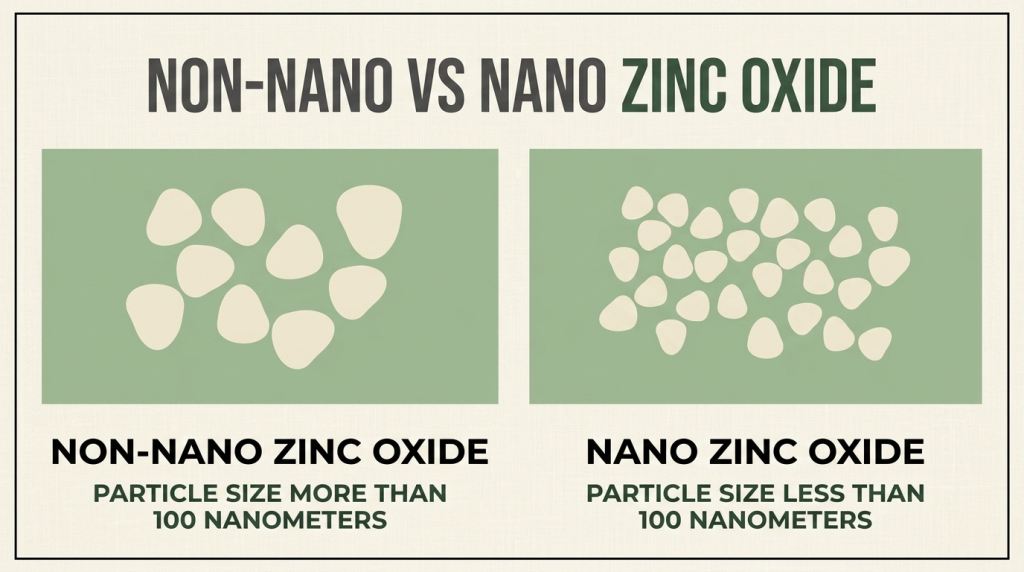
The “non-nano” distinction matters. Nano-sized zinc oxide particles, used in many conventional mineral sunscreens to reduce white cast, are small enough that absorption through the skin becomes a real concern. Non-nano particles are too large to penetrate the skin barrier, which is precisely the point.
Zinc oxide has one of the strongest safety profiles of any sunscreen ingredient. It has been used in wound care, diaper rash treatments, and baby skincare for generations. The FDA classifies it as generally recognized as safe and effective, one of only two sunscreen ingredients to receive that designation. The other is titanium dioxide.
The Mineral Sunscreen Pushback: Addressed Honestly
Is mineral protection “as effective” as chemical sunscreen?
It depends entirely on what you mean by effective.
If effective means the highest possible SPF number on a lab test, then yes, many chemical formulas will score higher. SPF is measured under very specific laboratory conditions that do not reflect how most people actually apply and reapply sunscreen in the real world.
If effective means a physical barrier that provides reliable, broad-spectrum protection, does not degrade in sunlight the way some chemical filters do, does not require absorption into your skin to function, and is safe for daily use on children and sensitive skin, then mineral protection is not just effective. It is the better choice for a lot of people.
This is a different product. Not an inferior one. Different.
The white cast is real. We are not going to pretend otherwise. Applying it properly, working it into the skin in sections rather than slapping it on all at once, makes a significant difference. For deeper skin tones, the white cast is more pronounced, and that is a legitimate consideration.
Reapplication matters more with mineral protection because zinc oxide can be physically wiped or washed away. After swimming, sweating, or toweling off, you need to reapply. This is true of all sunscreens, but especially important with mineral formulas.
If you have spent your whole life using conventional sunscreen and have no concerns about the ingredient list, this product is probably not for you, and that is completely fine. But if you have been looking for an alternative that puts ingredient safety first, mineral protection is not a compromise. It is a solid choice.
The Sensitive Skin Case
Sensitive skin and chemical sunscreens have a complicated relationship. Many of the most common sunscreen reactions, redness, stinging, breakouts, and contact dermatitis, are triggered by chemical UV filters rather than the sun itself.
Oxybenzone, fragrances, and preservatives commonly found in conventional formulas are among the most frequent triggers for contact allergic reactions in people with reactive skin. For anyone managing eczema, rosacea, or general skin sensitivity, switching to a fragrance-free mineral formula often eliminates the reaction entirely.
Children’s skin is thinner and more permeable than adult skin, which means whatever is applied to it is absorbed more readily and more completely. This is why the ingredient conversation matters more, not less, for the youngest members of your family.
Tallow, the rendered fat we use in our Sun Balm Stick, deserves a specific mention here. It is structurally similar to the fatty acids found naturally in human skin, which means it integrates readily without triggering the immune response that many synthetic ingredients do. For skin that reacts to almost everything, tallow-based formulas are often remarkably well tolerated.
Practical Sun Management
Smart sun management is not complicated. A few principles cover most of it.
Time your exposure. UV index is highest between 10am and 2pm, (some sources extend this to 4pm), peaking around solar noon when the sun is at its highest point in the sky. This surprises a lot of people because the hottest part of the day often feels like the most dangerous. But heat and UV are not the same thing. A hot afternoon in the shade carries far less UV exposure than a cool morning in direct sun. UV intensity is driven by the sun’s angle, not the temperature. Morning sun, especially before 10am, carries significantly lower UV load and is when the benefits of sunlight exposure are highest relative to the risks.
Shade and clothing first. A wide-brimmed hat eliminates most of the UV exposure to your face. Lightweight long sleeves cover more skin than any sunscreen formula. These are your primary tools. Sunscreen fills the gaps.
Hydration matters. Well-hydrated skin is more resilient to UV stress. Drink water. Apply a nourishing moisturizer. (We have many to choose from!) Skin that is healthy from the inside handles sun exposure better.
Reapply honestly. No formula lasts all day. After swimming, sweating, or two hours of continuous exposure, reapplication is not optional if protection is the goal.
After sun care is real. Sun exposure depletes the skin’s moisture barrier. Cooling, hydrating, and restoring pH balance after a long day outside is not indulgent. It is maintenance.
How to Read a Sunscreen Label
Look for: Non-nano zinc oxide as the active ingredient, fragrance-free formula, minimal ingredient list you can actually read, broad spectrum notation, clean carrier oils like jojoba, avocado, or coconut
Avoid: Oxybenzone, octinoxate, avobenzone, octocrylene, homosalate, added fragrance or parfum, parabens, PEGs, anything you cannot identify or pronounce
Greenwashing flags: “Natural” without specifying ingredients, “reef safe” without confirming oxybenzone and octinoxate free, “mineral blend” that still contains chemical filters, high SPF numbers on mineral formulas without transparency about how they were tested
A Note on How We Approach This
When we started making sun protection products, we did not set out to build a sun care line. We set out to solve a problem for our own family. Six kids, a lot of time spent outside, and an ingredient list we were no longer comfortable with in conventional products.
Our Sun Guard Lotion, Sun Balm Stick, and After Sun Spray exist because we wanted something we could reach for without thinking twice. Non-nano zinc oxide as the active ingredient. Carrier oils that nourish rather than strip. Simple formulas with nothing extra.
We are not claiming to have invented anything new. Mineral protection has existed for decades. We are just making it in small batches, with ingredients we would put on our own children, for families who are asking the same questions we started asking.
If that is you, we would love for you to try it.
Footnotes:
- Forrest KY, Stuhldreher WL. Prevalence and correlates of vitamin D deficiency in US adults. Nutrition Research. 2011;31(1):48-54.
- Matta MK, Zusterzeel R, Pilli NR, et al. Effect of Sunscreen Application Under Maximal Use Conditions on Plasma Concentration of Sunscreen Active Ingredients. JAMA. 2019;321(21):2082-2091.
- Centers for Disease Control and Prevention. National Report on Human Exposure to Environmental Chemicals. Oxybenzone biomonitoring data. Available at: cdc.gov/exposurereport
- Downs CA, Kramarsky-Winter E, Segal R, et al. Toxicopathological Effects of the Sunscreen UV Filter, Oxybenzone (Benzophenone-3), on Coral Planulae and Cultured Primary Cells and Its Environmental Contamination in Hawaii and the U.S. Virgin Islands. Archives of Environmental Contamination and Toxicology. 2016;70(2):265-288.